AI and charities: it’s all about purpose
Posted on 30 Sep 2026
There's been a lot of talk about AI this week, and some of it has been frightening. So, is AI good…
Posted on 26 Mar 2024
By Greg Thom, journalist, Institute of Community Directors Australia
Generational change is upending traditional charitable giving patterns according to new research.
A study by social research firm McCrindle has found donors are moving from predictable committed giving toward more spontaneous need-driven giving.
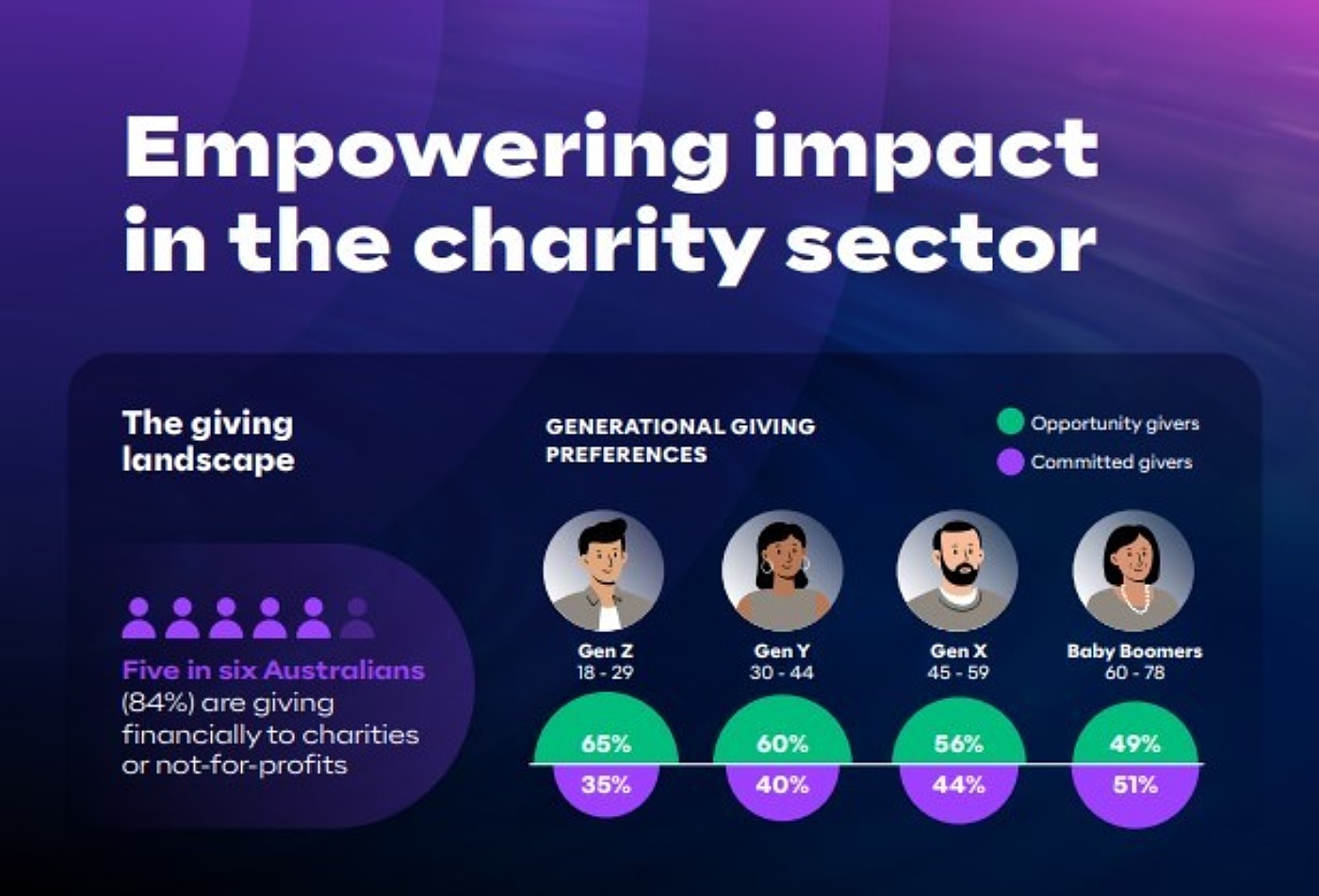
The change is being spurred by Gen Z donors (aged 18–29), who are more likely to give when they hear about a need or issue in the community or are approached to donate or offer support.
More than half of Baby Boomers (aged 60–78), by contrast, are committed givers who donate semi-regularly throughout the year or on a regular basis.
McCrindle's director of advisory, Ashley Fell, said the evolution in giving patterns meant the sector's stable donation base was shifting, something that could have significant implications for charities and not-for-profits.
While 38% of all donors give to a charitable organisation when they hear about a need or issue, at the other end of the scale, just 13% give on a frequent or regular basis – down from 17% in 2017.
“This means that a committed, consistent revenue stream for charities is coming under some pressure, and we believe that it is essential to understand the way that donors are choosing to engage so that charities can design fundraisers that maximise that engagement,” Ms Fell said.
“For instance, with 38% [of all donors] who give when they hear about a need or an issue, it’s important to not rely solely on annual campaigns, in terms of engaging them but exploring how to amplify the cause and provide multiple opportunities for people to respond throughout the year.”
Ms Fell made the comments during the online launch of a new McCrindle research report, Empowering Impact: Understanding giving behaviour, volunteering, and advocacy in the not-for-profit landscape.

The report found that an increasing number of charitable givers are cause-driven and choose to give on their own terms - responding on a needs basis rather than committing to a single organisation.
Key findings include:
“I’ve been speaking to a few NFP leaders over the past few weeks and it’s a really interesting landscape to be thinking about with regards to engaging these younger generations of donors.”
The report found that younger generations are more likely than their older counterparts to be opportunity givers, with 65% of Gen Z in this category compared to 49% of Baby Boomers.
More than 60% of Gen Y (aged 30-44) and 56% of Gen X (45-59) also favour opportunity giving.
More than half (51%) of Baby Boomers, however, are considered committed givers, compared to just 35% of Gen Z.
“I’ve been speaking to a few NFP leaders over the past few weeks and it’s a really interesting landscape to be thinking about with regards to engaging these younger generations of donors,” said Ms Fell.
She said one question she had been asked consistently was difficult to answer:
“Is it worth engaging with these younger people when they’re not giving in the same ways and are in some ways not as engaged or committed as older generations who many organisations and NFPs rely on for that committed, consistent behaviour?”
“Our [McCrindle's] definite belief as an organisation is, even though it’s hard, yes it’s definitely worth it.”
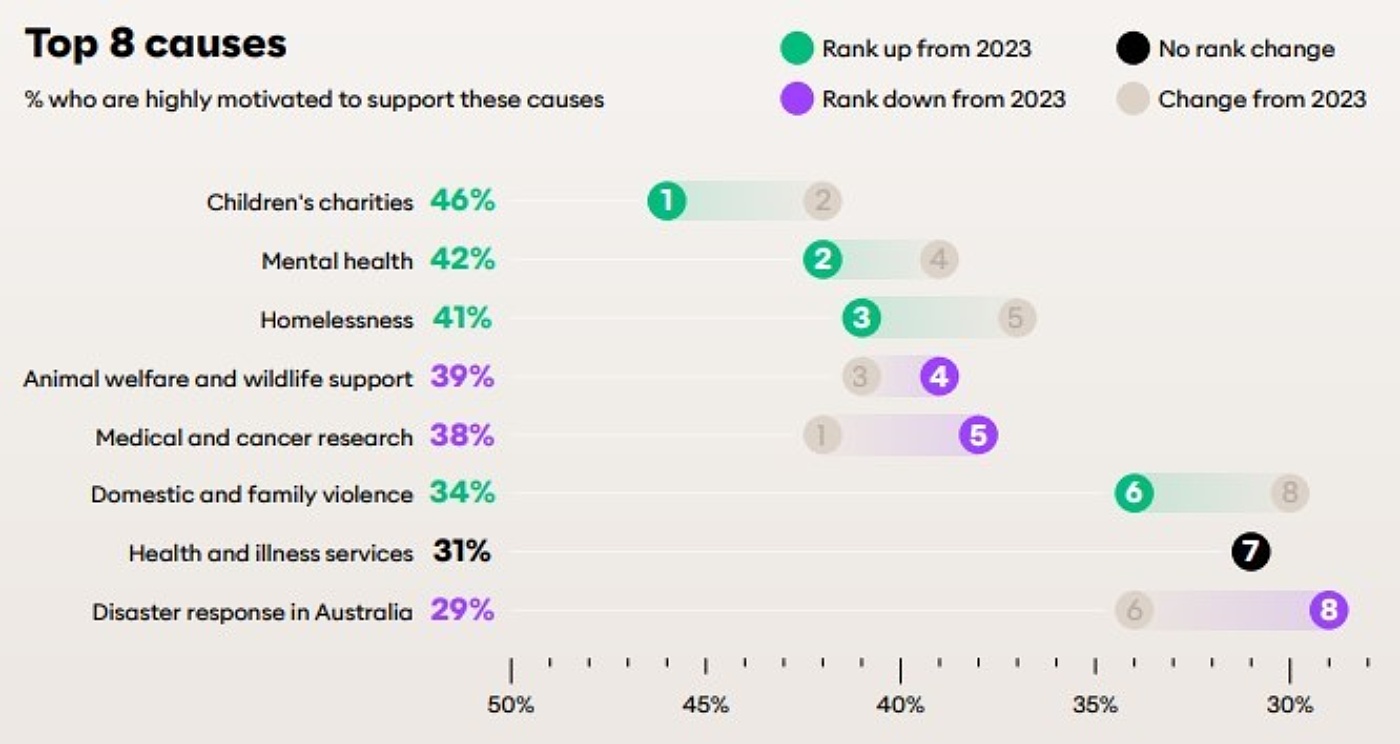
Children’s charities, mental health and homelessness top the list of causes Australians donated to and volunteered with in 2024.
McCrindle's director of advisory, Ashley Fell, said that after years of little change in the top three rankings, there had been a repositioning this year.
“We have seen a steady climb in support for the cause of mental health from 29% in 2017 to 42% today, and this is largely being driven by younger donors,” she said.
“More than half of Gen Z are highly motivated to give financially or to volunteer for an organisation associated with this area.”
This compared to just over 40% for Gen Y and Gen X and 28% for Baby Boomers.
The entry of children’s charities, mental health and homelessness into the top three came at the expense of animal welfare and wildlife support, medical and cancer research and Australian disaster response, which all fell in the rankings compared to the previous year.
“What we are seeing here is that younger donors are driving support for the causes of mental health as well as youth support and human rights,” said Ms Fell.
“By comparison, the older generation givers and the Baby Boomers are giving support for medical and cancer research and disaster response in Australia.”
Ms Fell said while younger generations are more likely to be opportunity givers, this does not mean they give less frequently or are less generous than their older counterparts.
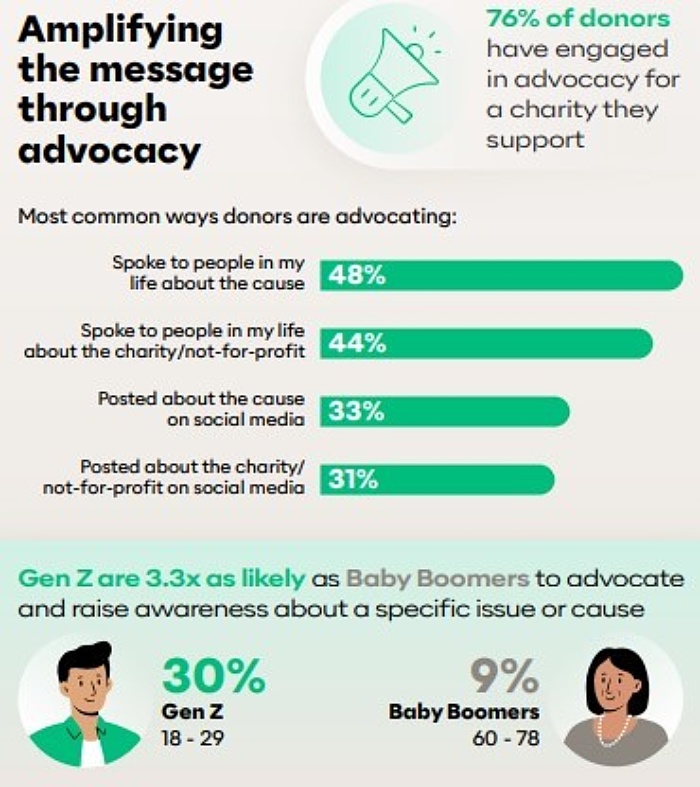
The report revealed Gen Z donors are more likely than Baby Boomers to give at least monthly and are more likely to have donated $200 in the past 12 months.
Generation Y, who are in their prime years in terms of earning capacity, are also more likely to be generous with two out of five (41%) donating $200 or more in the past year.
“As we think about these donations especially in regard to younger givers, we have to keep in mind that these donations are ... often spread among different charities and a greater variety of charities than the committed giver who might be more committed to one or two organisations,” said Ms Fell.
She said this again highlighted the challenge for charities in deciding where to spend their limited resources.
“Do you focus on a smaller proportion of committed givers and higher value givers or engage numerous smaller givers?
“Of course, there are risks associated with each of these options, but engaging the future donor to ensure the long-term sustainability and viability of your organisation, is essential we believe.”
Posted on 30 Sep 2026
There's been a lot of talk about AI this week, and some of it has been frightening. So, is AI good…

Posted on 30 Sep 2026
After the biggest AFL game of the year, one player proudly wore the flag of his birth country and…
Posted on 30 Sep 2026
At 21 years old, Tate Donohoe is the founder of Ecodia, an AI-assisted software development company…

Posted on 30 Sep 2026
I am checking if this is in the right spot. Let's see.
Posted on 30 Sep 2026
More than 200 fully funded Centre for Social Impact (CSI) scholarships will help equip for-purpose…

Posted on 30 Sep 2026
Personal stories are among the most powerful tools a charity can have to raise funds and awareness,…

Posted on 23 Sep 2026
In his new book Our Place, policy expert Matt Lloyd-Cope argues that housing must be at the heart…

Posted on 23 Sep 2026
There are solutions to counter the rise of One Nation but they might not be residing in the mess…
Posted on 23 Sep 2026
A just-released major global survey of charities has found that demand for charity assistance has…
Posted on 23 Sep 2026
Fresh from welcoming delegates to last week’s Philanthropy Australia conference in Brisbane,…
Posted on 23 Sep 2026
A national strategy to develop Australia's regional cities is needed to break the housing…

Posted on 23 Sep 2026
Eight years after a report to Treasury first suggested the charities regulator should be more…